menu
close
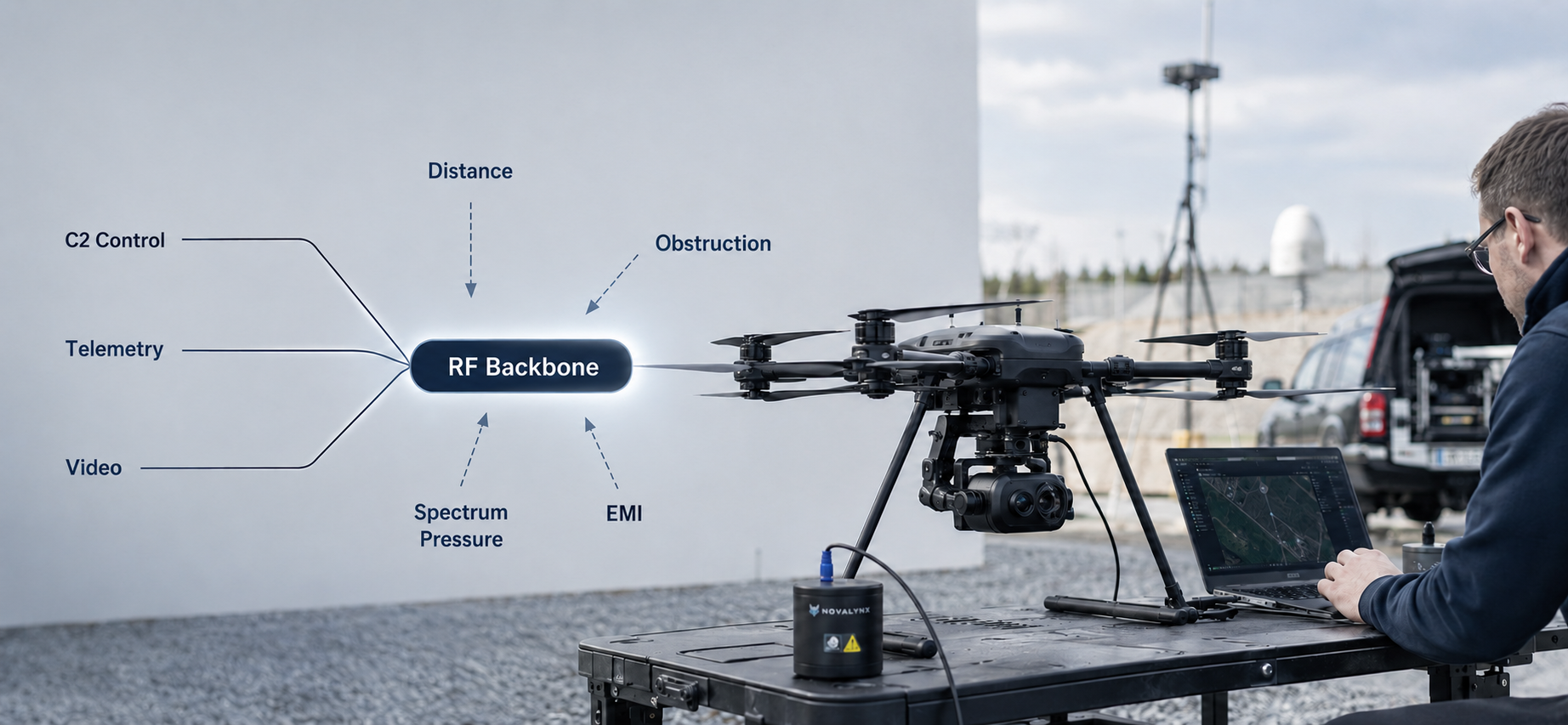
UAV communication failures are often discovered late — during field testing, payload validation, or site acceptance.
By then, the problem is rarely only signal strength.
A video feed may drop. Telemetry may become unstable. Control response may become less predictable at longer range. The first reaction is usually to check the RF module, antenna setup, bandwidth, or transmit power.
Those checks are necessary. But they do not always reach the deeper risk.
For many UAV integrators, the real design question is whether too much of the mission depends on one RF backbone.
Public industry reporting has shown growing attention to reducing RF control-link exposure in high-interference environments. For UAV teams, the larger lesson is not to copy one configuration, but to review where RF dependency creates architecture exposure.
When C2 control, telemetry, and video transmission all rely on the same RF path, the system carries a concentration risk. In clean tests, that risk may stay hidden. Under distance, obstruction, spectrum pressure, or EMI-heavy sites, it can become a project reliability issue.
RF is not the problem. RF dependency is the architecture risk.
A UAV communication system does not carry one task.
C2 control keeps the aircraft responsive.
Telemetry helps the operator read aircraft status.
Video transmission supports inspection, payload operation, situational awareness, and customer reporting.
When these paths share one RF backbone, a single communication condition can affect several parts of the mission at the same time.
That is where the risk becomes larger than signal quality.
A weak video feed may delay operator decisions.
Telemetry gaps may reduce confidence in aircraft status.
Control-link instability may force the team to stop, retest, or redesign part of the deployment plan.
For UAV integrators, this does not stay inside the engineering team. It can create reflights, late-stage field adjustment, delayed acceptance, and difficult conversations with customers about reliability.
In most UAV projects, RF still has a role. The concern starts when every critical communication path depends on it.
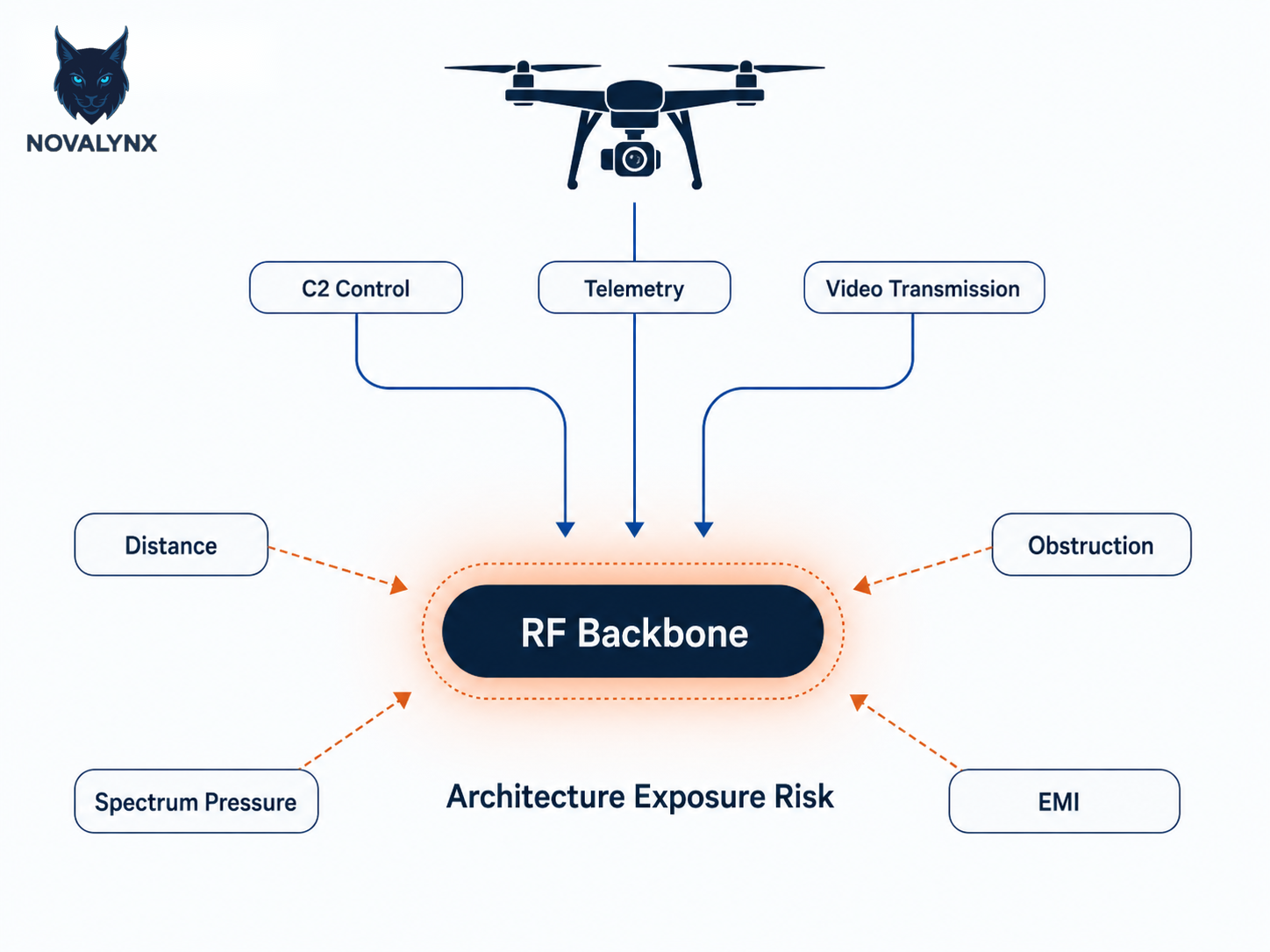
Bench tests and short-range trials often make RF-only communication look acceptable. The environment is controlled. The distance is limited. Obstruction is low. Spectrum pressure may be lighter than it will be on site.
Deployment changes the picture.
As distance increases, link margin becomes harder to preserve. A design that performs well at short range may behave differently when antenna position, aircraft movement, and site conditions become less controlled.
If C2, telemetry, and video all depend on the same RF path, reduced margin does not affect only one function. It places the full communication workflow under pressure.
Buildings, terrain, vehicles, industrial structures, and temporary site equipment can all affect line-of-sight conditions.
For industrial inspection, border monitoring, long-range UAV work, and ISR payload integration, this matters because site conditions are rarely static. A communication architecture that relies too heavily on one RF layer can become difficult to trust when the environment changes during the mission.
UAV projects do not operate in empty RF space.
Nearby communication systems, other UAVs, industrial equipment, and local transmissions can all add pressure. A stronger RF module may help in some cases, but it does not remove the risk of placing too much mission continuity on one RF path.
Industrial sites, power infrastructure, and dense equipment areas can raise EMI concerns. In these environments, RF-only dependence should be reviewed carefully.
The practical question is simple:
What happens if RF quality drops during a key part of the mission?
If the answer is that C2, telemetry, and video may all be affected together, the architecture deserves review before field deployment.
Many UAV communication discussions still start with RF performance.
How far can it transmit?
How stable is the link?
How much bandwidth does it support?
How does it behave under interference?
These are valid questions. They are not the only questions.
A stronger RF module can improve one part of the communication design. It does not automatically reduce the risk of concentrating several mission functions on one RF backbone.
Architecture-level review asks a different set of questions.
These questions are not only technical. They affect delivery, testing, acceptance, rework, and customer confidence.
That is why RF dependency should be treated as a UAV communication design risk, not only a signal issue.
If your UAV project carries C2, telemetry, and video over one RF backbone, NovaLynx can help review whether a fiber-enabled or hybrid communication path should be considered before field testing or site acceptance.
A fiber-enabled or hybrid communication path should not be presented as a universal fix.
It does not remove every UAV communication risk. It does not replace sound control design, RF planning, payload integration, interface validation, or field testing.
Its value is more specific.
A fiber-enabled UAV communication path can help reduce how much selected communication depends on RF. For certain UAV architectures, moving part of the communication workload onto a physical transmission layer can reduce RF exposure and lower the concentration risk created by RF-only dependence.
This can be relevant when the project involves long-range communication, high-bandwidth video, EMI-heavy sites, or operating conditions where RF quality may change during deployment.
The goal is not to remove RF from the system.
The goal is to prevent RF from becoming the single point of communication risk.
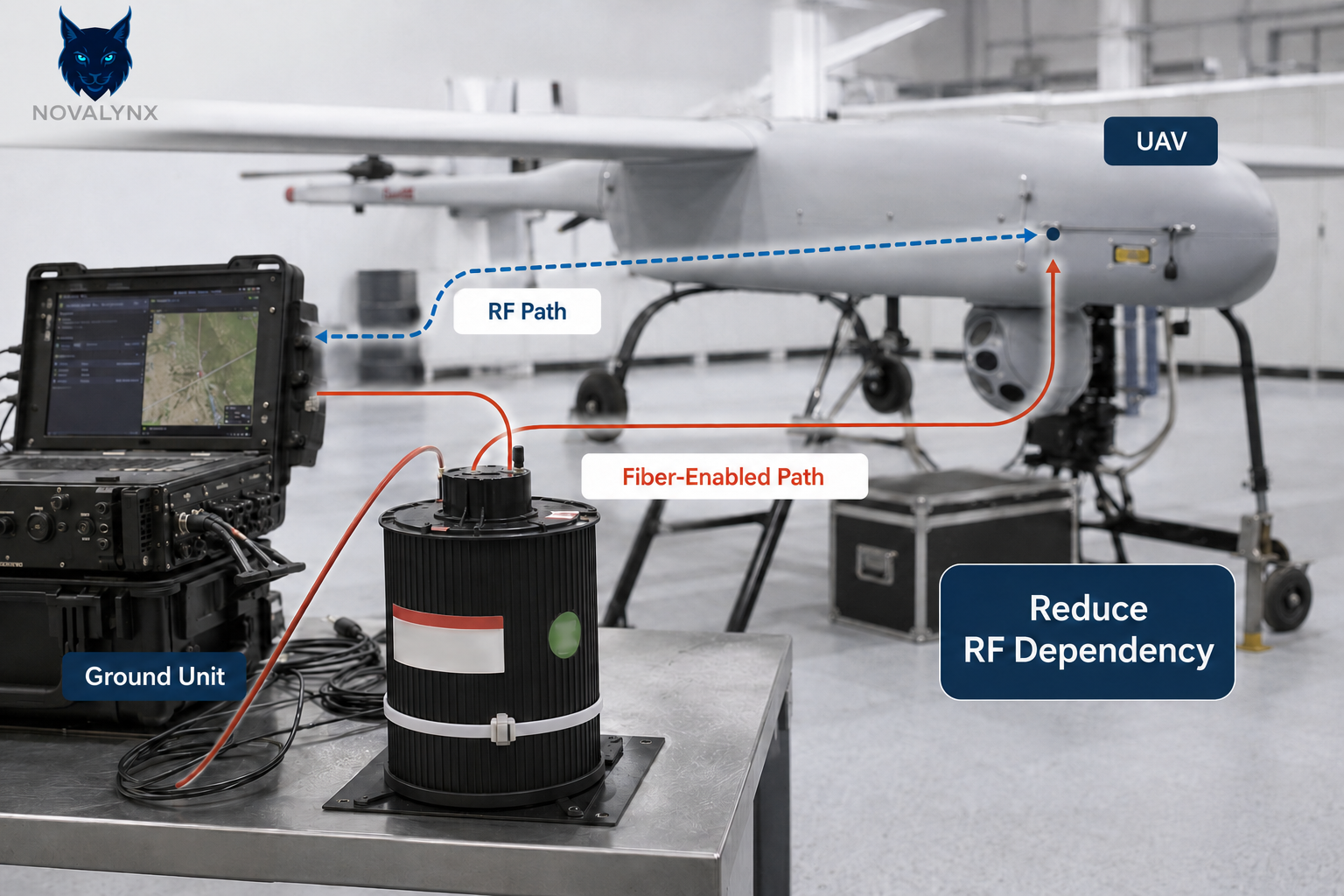
NovaLynx fits this discussion as an architecture support option, not as a blanket promise.
For UAV integrators and project teams reviewing communication reliability, NovaLynx supports fiber-enabled and hybrid UAV communication architecture where reducing RF dependency is part of the design requirement.
This matters when a team needs to separate selected communication paths from RF exposure, reduce uncertainty before deployment, or review whether video, telemetry, and control should all remain on the same RF backbone.
NovaLynx also emphasizes traceable G.657.A2 fiber source and inspection before shipment. For UAV integration, fiber quality is not only a purchasing detail. Bend tolerance, traceable sourcing, and pre-shipment inspection can help reduce uncertainty before deployment.
Fiber should be treated as a standard boundary, not only a sourcing label.
The boundary should stay clear.
Fiber is a physical transmission layer and is not exposed to RF conditions in the same way as wireless links. Moving selected paths away from RF can reduce RF dependency in the overall architecture.
But project-specific parameters — including latency targets, supported interfaces, link distance, EMI conditions, and deployment configuration — should be confirmed during technical review before final integration.
NovaLynx should not be described as able to remove all interference risk or guarantee mission success. The more accurate value is this:
NovaLynx helps UAV teams review where a fiber-enabled or hybrid communication path may reduce RF-only architecture exposure.
Before choosing another RF module, UAV teams should review the current communication design.
Are C2 control, telemetry, and video transmission all depending on one RF backbone?
If RF quality drops, which function is affected first?
If the video feed becomes unstable, does it only affect image quality, or does it delay payload decisions and project acceptance?
If telemetry becomes unreliable, can the operator still maintain enough confidence in aircraft status?
If the deployment site includes obstruction, spectrum pressure, or EMI-heavy equipment, has the architecture been reviewed under those conditions?
Which communication path would create the highest cost if it failed during field testing?
Which path could be moved to a lower RF exposure physical layer?
These are the questions that help integrators move from component selection to risk control.
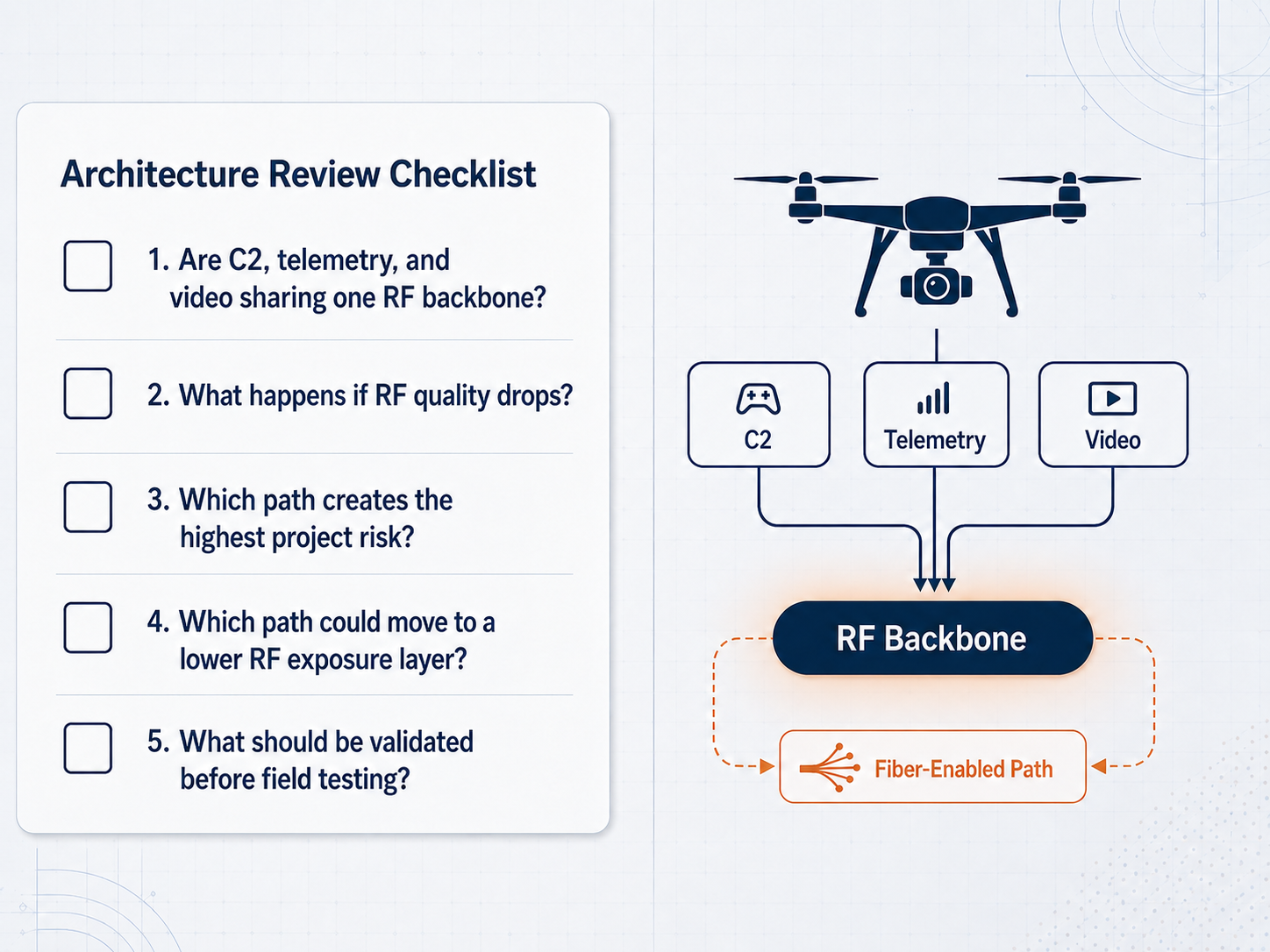
RF will remain part of UAV communication. The issue is not RF itself.
The issue is dependence.
When C2, telemetry, and video transmission all sit on the same RF backbone, the design may look acceptable in clean tests but become exposed during field deployment, payload validation, or site acceptance.
For long-range UAV projects, ISR payload integration, industrial inspection, border monitoring, and communication system integration, this risk deserves attention before it becomes a project delay.
A fiber-enabled or hybrid communication path does not address every UAV communication issue. But it can help reduce RF dependency where selected communication paths need a lower RF exposure transmission layer.
Before RF becomes the single point of communication risk, review the architecture.
No. RF is still necessary in many UAV systems. The risk appears when C2 control, telemetry, and video transmission all depend on one RF backbone without architecture-level risk review.
Not in most cases. A fiber-enabled or hybrid path is better understood as a way to reduce RF dependency for selected communication paths. RF may still remain part of the overall system.
A project should consider it when RF dependency creates delivery risk, especially in long-range communication, high-bandwidth video, EMI-heavy sites, or deployments where obstruction and spectrum pressure may affect communication stability.
They can start by reviewing which paths depend on RF, what happens if RF quality drops, which function creates the highest project risk, and whether selected paths should move to a physical transmission layer.
NovaLynx can help UAV teams review whether a fiber-enabled or hybrid communication path fits their integration project. Platform type, communication paths, distance target, interface requirements, and deployment conditions should be reviewed before final design.
If your UAV project carries C2, telemetry, and video over one RF backbone, it may be time to review the architecture before field testing or site acceptance.
Share your UAV platform type, communication paths, distance target, interface requirements, and deployment conditions with NovaLynx.
Contact NovaLynx to discuss whether a fiber-enabled or hybrid communication path fits your UAV integration project.
NovaLynx helps customers solve interference and communication reliability challenges in complex UAV and mission-critical scenarios. Our solutions cover fiber optic systems, anti-jamming communication modules, and tailored integration support based on real operational needs.