
menu
close
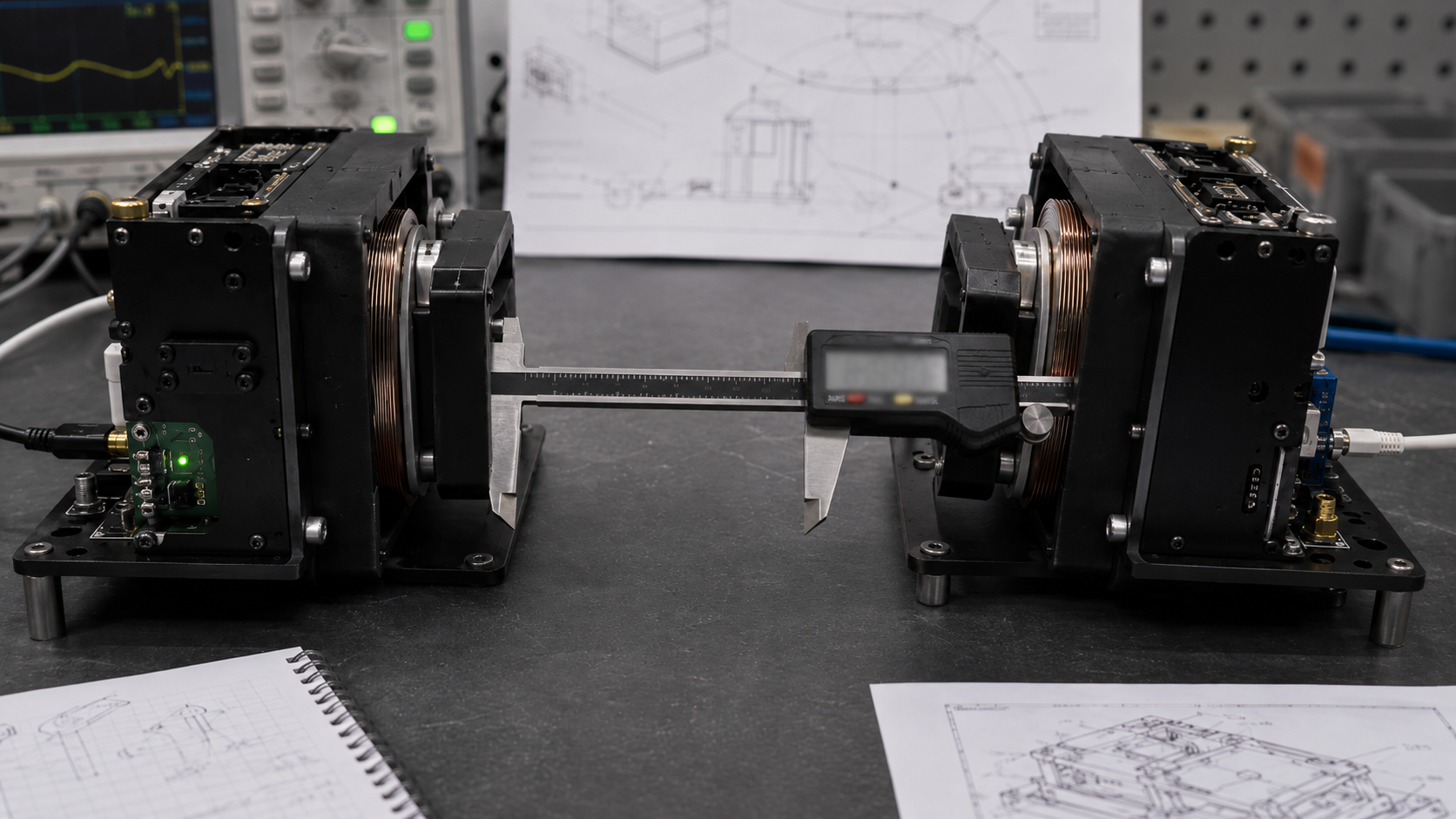
Magneto-inductive communication uses coupled magnetic fields between transmitting and receiving coils to carry data across a limited separation. That makes it relevant to some short-range links, especially where conventional radio propagation is difficult or a continuous physical route is hard to maintain.
It does not make magnetic communication a substitute for fiber, RF, or a complete communication architecture.
Consider a confined-space inspection crawler approaching a structural section where RF performance drops and routing a continuous fiber path through the local geometry becomes difficult. The platform still needs a recovery trigger, a small set of commands, and basic health status. Video remains on another path.
A magneto-inductive link may deserve testing for those functions. But the decision cannot stop at “the nodes connected.”
The platform must still hold the required gap and coil angle. The link must carry the defined data at the required update rate. Power, mounting space, movement, degradation detection, and fallback behavior must all be accounted for.
That question determines whether a magneto-inductive path deserves further review, whether RF or fiber should remain responsible for the role, or whether several paths belong in a hybrid communication architecture.
Fiber-enabled communication, RF, and magneto-inductive communication move engineering pressure to different parts of the platform.
Fiber can carry high data volumes with low transmission delay through a controlled physical route. Its burden lies in routing, payout, bend management, connectors, handling, and recovery.
RF supports mobility without a deployed line. Its performance depends on propagation, antenna placement, surrounding structures, interference conditions, spectrum access, and range.
A magneto-inductive link avoids a continuous cable across the local gap, but depends on separation, coil geometry, orientation, medium, power, movement, and installation.
A hybrid architecture does not remove these constraints. It assigns different roles to different paths so that one path is not expected to do everything.
The choice should begin with the role: what data must cross the link, how often it must arrive, how far it must travel, what changes during movement, and what happens if the link weakens or stops.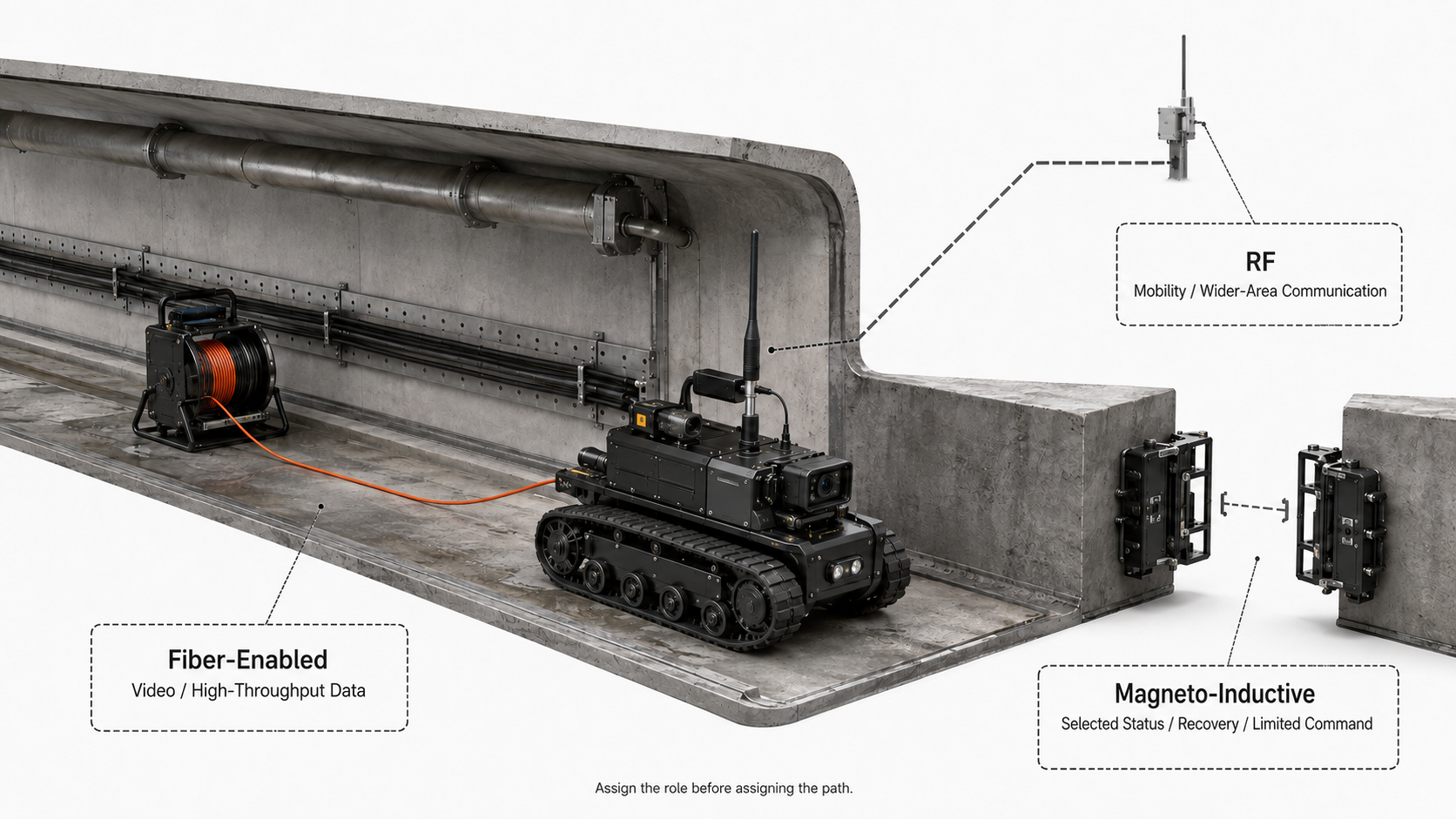
Magneto-inductive communication is most relevant when the intended function is selected, short-range, and lower-rate, and when the platform can maintain the required coupling conditions.
Possible cases include subsystem state, battery status, readiness, limited condition reporting, or a small set of fault indicators.
These roles may use small packets at defined intervals, but “telemetry” is still too broad unless the exact data and update requirement are stated. A battery percentage every few seconds is not the same task as continuous navigation data or a dense sensor stream.
A limited enable, disable, configuration, mode-change, or recovery command may deserve review under controlled conditions.
That is different from continuous control of a moving platform, which normally imposes tighter limits on update frequency, interruption, delay variation, and failure response.
Alarm, recovery, local handshake, and selected telemetry can be relevant because the payload may be small.
Yet low data volume does not mean low consequence. A missed recovery trigger may matter more than a larger non-critical stream. The role must be judged by its operational consequence, not only by packet size.
A magneto-inductive link should not be the default path for continuous HD video, high-volume sensor feeds, or other high-throughput data.
A packet crossing an obstacle once does not show that the link can sustain the bandwidth, continuity, and duration required by video or dense payload streams.
It should also not be treated as the default long-distance control backbone. As separation grows or orientation changes, the conditions that support coupling may become harder to maintain.
RF may remain appropriate for mobility and wider-area communication. Fiber may remain appropriate for high-throughput traffic where a physical route can be managed.
Placing status, command, alarm, and recovery on one unverified path can concentrate system exposure. The consequences of degradation are not the same for each role.
Architecture review should separate them before deciding whether they can share a link.
Selecting a communication path before defining the role and operating envelope can create more than poor link performance.
The platform may be packaged around a coil position that cannot be maintained during movement. The enclosure may leave too little clearance. Bench power may hide a platform limit. A fallback path may share the same power or mounting dependency as the primary link.
These issues often appear after mechanical layout, interfaces, wiring, or operating procedures have already been fixed. The result may be a revised enclosure, changes to the interface or power allocation, a narrower operating envelope, another round of platform testing, or the late removal of the path.
A bench connection can reduce uncertainty. Used carelessly, it can also create false confidence.
The question is not simply whether the link works. The question is whether the installed platform can keep it inside the required operating conditions.
| Variable | What Must Be Defined | Why It Matters |
|---|---|---|
| Distance | Minimum, nominal, and maximum separation; expected variation | A working nominal gap may not survive platform motion |
| Medium | Air, water, soil, rock, concrete, pipe wall, structural material, or mixed boundary | A bench medium may not represent the installed path |
| Coil size | Geometry, weight, mounting area, and available volume | Electrical feasibility may conflict with platform layout |
| Coil orientation | Nominal alignment, angular tolerance, vibration, rotation, and mounting play | Angle changes may move the link outside the tested condition |
| Data requirement | Payload size, update frequency, direction, continuity, and acceptable interruption | A successful packet does not prove role suitability |
| Power | Continuous and peak demand, duty cycle, heat, and low-power behavior | Bench supply may hide platform limits |
| Movement | Relative motion, vibration, rotation, changing gap, and intermittent misalignment | Static testing can overstate platform usability |
| Integration | Mounting, interfaces, nearby electronics, inspection, and maintenance access | An isolated node may behave differently after installation |
These variables interact. A larger coil may help one aspect of the link but create a mounting problem. More transmit power may improve a test condition while exceeding the platform budget. A nominal gap may appear acceptable until vibration changes the angle.
Testing should represent combinations that can occur on the platform, not only one favorable arrangement.
“Underwater,” “underground,” “confined,” and “blocked” are useful descriptions. They are not architecture decisions.
A fixed local underwater link is not equivalent to communication between moving vehicles. Water type, separation, orientation, movement, installation, and the assigned role all need separate definition.
Underground may describe soil, rock, a tunnel, a mine passage, buried infrastructure, or a pipe wall. Those are not interchangeable test conditions.
A blocked section may create fiber-routing pressure without removing fiber from the wider architecture. Fiber may remain responsible for video or other high-volume data. A local RF problem also does not remove RF from every part of the platform.
The better question is where each path remains useful and whether adding another path removes a real failure dependency.
A bench connection can establish that two defined nodes communicated at a defined distance, orientation, medium, power setting, and data configuration.
That is useful evidence. It is also limited evidence.
It does not show that the platform can maintain the same gap and coil angle during movement, that the nodes fit the available volume, that the assigned role can tolerate interruption, or that the fallback path is independent.
Evaluation should move from nominal connection to tolerance testing, motion testing, platform installation, degradation review, and a final role assignment.
Current NovaLynx Evaluation Boundary
NovaLynx currently treats magneto-inductive communication as an engineering evaluation path. Bench work may establish that a link exists under controlled conditions. It should not be presented as proof of platform range, movement tolerance, environmental qualification, or suitability for a primary control backbone unless those conditions have been separately tested and documented.
This boundary lets the evidence guide the next test without being used to claim more than it proves.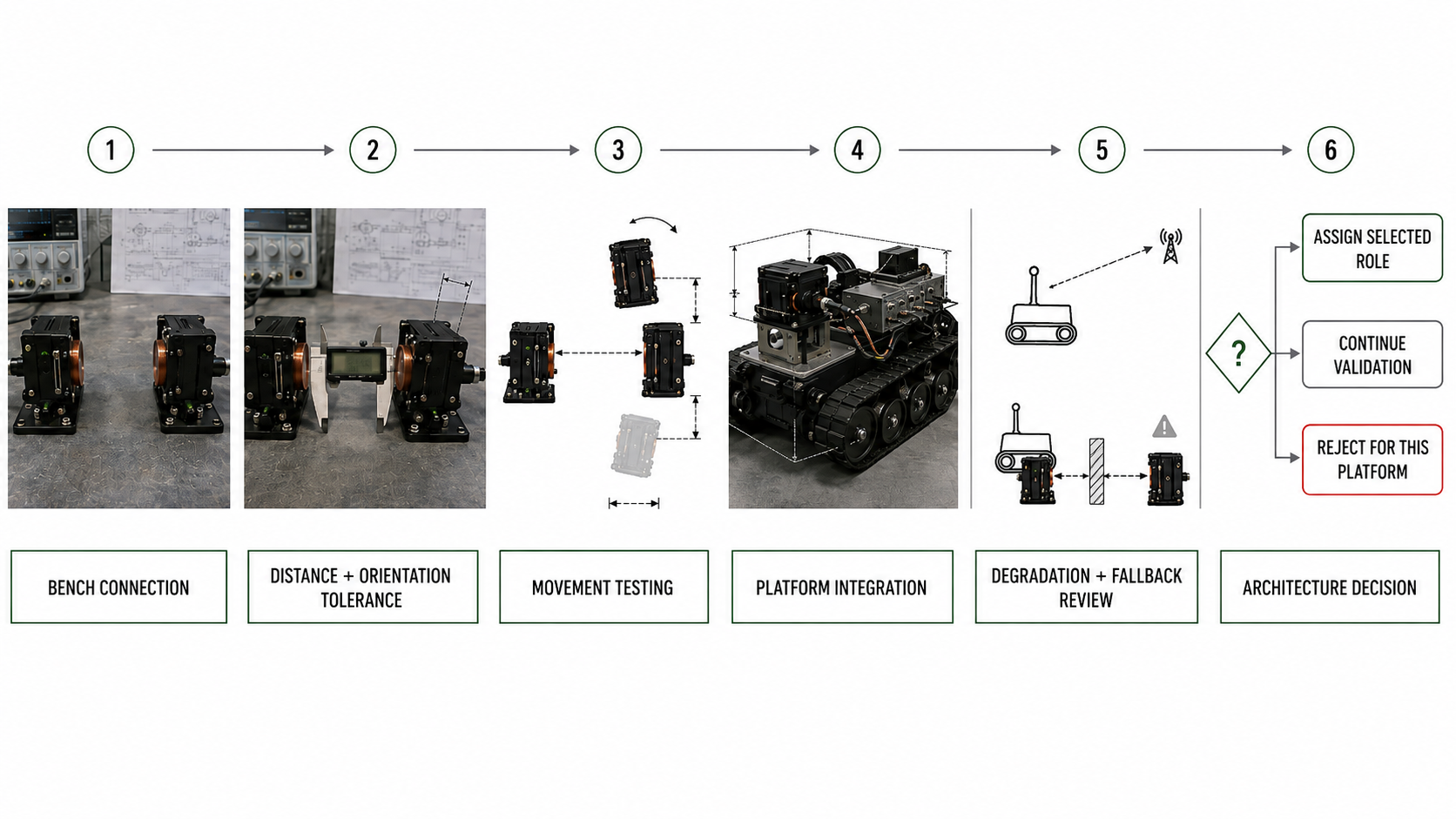
A communication path should not be approved without a degradation plan.
The team must know what happens when data becomes slower, intermittent, delayed, corrupted, or unavailable, and whether the change can be detected before the assigned function is lost.
A delayed status update may allow limited operation. An intermittent command link may require the platform to hold position. Loss of an alarm or recovery path may require another independent action.
A second path only counts as fallback if it removes the failure dependency that matters. Two paths tied to the same power source, mounting point, interface, or operator action may fail together.
NovaLynx structures an early communication architecture review around five questions: Role, Envelope, Integration, Degradation, and Fallback.
Define the exact function and the consequence of delay, interruption, corruption, or loss.
Define separation, medium, orientation, movement, vibration, operating duration, and environmental exposure.
Define coil size, mounting, available volume, weight, power, interfaces, nearby electronics, inspection access, and maintenance access.
Define how degradation is detected, which function is affected, how long interruption can be tolerated, and what restricted state follows.
Identify whether RF, fiber, another local link, stored autonomy, or a recovery action remains available—and whether it avoids the same relevant failure dependency.
This review does not preselect a technology. It decides what deserves testing, what evidence is missing, and which path should carry each role.
The output should be more specific than “magnetic communication works” or “fiber is difficult.”
A useful review may assign a magneto-inductive link one selected short-range, lower-rate role; retain RF for mobility; retain a fiber-enabled path for high-throughput traffic; divide roles across a hybrid architecture; revise the operating envelope; continue testing; or reject the magnetic path.
A negative decision can be valuable. Rejecting an unsuitable path before final integration may prevent more expensive mechanical, electrical, and software changes later.
NovaLynx does not begin by assuming that a reel, radio, fiber path, or communication module is the answer.
The review begins with the operational role, data requirement, operating environment, platform limits, degradation consequences, and fallback expectation.
That process may retain RF for mobility, assign fiber-enabled communication to high-volume data, review a magneto-inductive path for one selected short-range function, or divide roles across a hybrid architecture.
The purpose is to narrow the valid choices and define the evidence needed before integration.
Magneto-inductive communication may deserve review when a platform needs a selected short-range, lower-rate function and can maintain the required distance, coil geometry, orientation, power, movement, and installation conditions.
It should not be selected simply because the environment is underwater, underground, confined, or blocked. It is not the default path for continuous HD video, high-throughput data, or a long-distance control backbone.
A link can cross an obstacle and still fail the communication requirement.
The architecture decision begins when the role, operating envelope, integration limits, degradation behavior, and fallback path are all visible.
Share the required link role, operating distance, medium, node movement, data requirement, installation limits, power budget, and fallback expectation.
NovaLynx can use these inputs to structure an initial communication-path review covering:
Not as a general rule. Fiber may remain more appropriate for high-throughput data and controlled physical routes. A magneto-inductive link may deserve review for a selected short-range, lower-rate role when its operating conditions can be maintained.
It is not an automatic RF replacement. RF may remain necessary for mobility, changing separation, or wider-area communication. Magnetic communication may be reviewed for a local function where RF performance is limited and the coupling conditions can be controlled.
Possible review cases include status, limited command, alarm, recovery, low-volume handshake, and selected telemetry. Suitability depends on distance, medium, coil geometry, orientation, data requirement, power, movement, and platform integration.
It may deserve review in selected cases, but the environment label alone is insufficient. The medium, separation, motion, coil arrangement, data role, installation, and fallback behavior must be defined and tested.
Operating range depends on coil geometry, orientation, medium, power, receiver design, movement, installation, and the required data performance. A distance figure without those conditions is not enough for architecture approval.
It should not be selected by default for continuous HD video or high-throughput data. Those roles normally require sustained bandwidth and continuity beyond the typical review case for a selected short-range, lower-rate link.
It may carry one defined local function while RF or fiber carries other traffic. The architecture is useful only when each path has a clear role and the paths do not share the same relevant failure dependency.
NovaLynx helps customers solve interference and communication reliability challenges in complex UAV and mission-critical scenarios. Our solutions cover fiber optic systems, anti-jamming communication modules, and tailored integration support based on real operational needs.